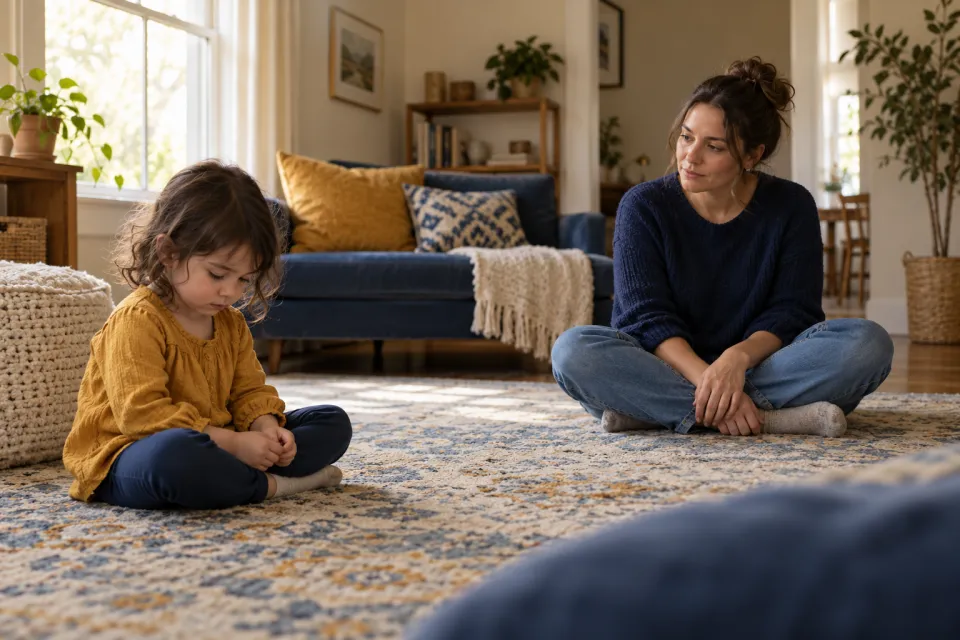
You do not need to turn the day into a project. Choose one moment you would like to understand better.
Describe the moment before explaining it
Imagine a child standing beside their parent when they arrive at a play session. “They do not like other children” is one interpretation. “They stayed beside me and watched the blocks for the first part of the session” records something the parent could actually see.
Those two sentences lead to different questions. The second leaves room to notice what happened next, whether the room was familiar, and whether joining felt easier on another day. This is an illustrative situation, not a report about a real family.
Try writing three short lines:
- The situation: Where were we, and what was about to happen?
- What I noticed: What did my child say or do?
- What happened next: What did I try, and what changed or stayed the same?
If you are unsure why something happened, leave that part open.
Where temperament fits
Temperament describes aspects of how a child tends to respond to the world. It can be one useful perspective on patterns such as approaching new situations or adjusting to change. It is not the only explanation for behaviour: experiences, surroundings and health can also matter. The American Academy of Pediatrics offers an introduction to this distinction. Read the explanation.
The idea of “goodness of fit” asks how adult expectations and the environment can work with a child's characteristics. It gives parents something to consider about their own response as well. University of Washington I-LABS.
Nine temperament traits in everyday life
These are ways to describe patterns, not nine tests to pass. The examples below are fictional; one moment cannot establish a trait. The American Academy of Pediatrics explains the broad dimensions.
- Activity: moving often during play, or choosing more still activities.
- Regularity: becoming sleepy at similar times, or having less predictable rhythms.
- Initial approach: reaching for unfamiliar play materials, or watching before touching.
- Adaptability: settling into a changed routine readily, or needing more time after the first response.
- Intensity: showing excitement with a big shout, or with a small smile.
- Mood: often responding cheerfully, or tending towards a more serious response across everyday moments.
Three more dimensions concern what catches attention and how an activity continues. Georgetown's Infant Toddler Temperament Tool defines these traits alongside the others:
- Sensitivity: noticing a faint background sound, or responding only when it becomes louder.
- Distractibility: turning from a puzzle when someone walks past, or continuing without looking up.
- Persistence: trying another way when a puzzle piece does not fit, or moving to something else.
Initial approach is the first response; adaptability is the adjustment that follows. A child can hesitate at the door and then settle into play. Distractibility concerns attention shifting; persistence concerns continuing through difficulty. A child might look up at a sound and then return to the tricky piece.
Goodness of fit does not mean being alike
An adult who enjoys quick changes can support a child who needs preparation. For example, the adult puts the lunch things ready, then helps the child finish one part of their drawing before moving on. The adult adjusts the transition rather than asking the child to become more like them. Head Start describes supporting a child's temperament through practical adjustments.
These ideas do not explain every behaviour or replace individual advice. See our approach and limits, or explore the fictional example report. The questionnaire has a narrower age range than this guide: ages 2–6.
Look for another example
Return to your note when a similar moment happens. You might find a repeated pattern, or you might find an important difference. Both are useful observations. You do not need to decide what kind of child you have.
A second caregiver may notice something else. Ask for a specific example and place it alongside yours. Treat the difference as another question to explore.
A small next step
Download Everyday observation notes and use it for one ordinary moment. You can keep it privately or bring it to a conversation with someone who knows your child.
If you have concerns about development, communication, distress or a change in behaviour, discuss them with your child's healthcare professional. Notes can help describe your concern; they do not establish a diagnosis.
Prepared with AI assistance. Examples and scripts are illustrative. This guide does not assess an individual child.
How we approach everyday observations