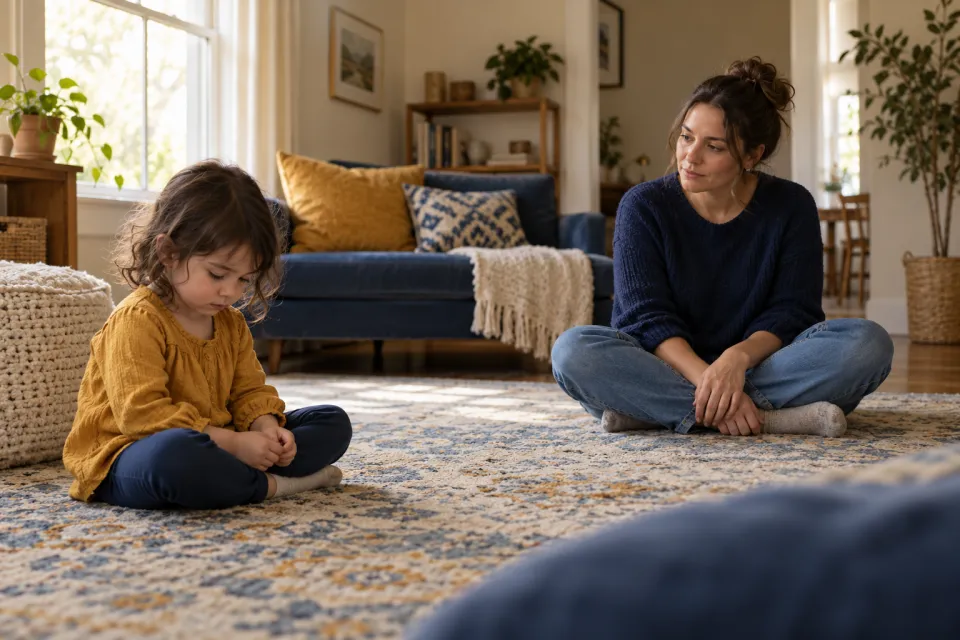
Think of one change you would like to understand better. It might be putting the blocks away before lunch or leaving home in the morning. Start with one situation rather than rewriting the whole day.
Notice where the difficulty begins
In this fictional example, a parent says, “Time to put everything away,” while a toddler is finishing a tower. The child protests. The parent records: I asked for the play to stop; the tower was unfinished; the next activity was not visible.
That note does not establish a cause. It makes the sequence easier to discuss and gives the parent something concrete to change next time.
Write down:
- What was your child doing?
- What did you say or show them?
- What happened next?
Prepare one part of the change
Head Start suggests approaching the child, giving notice before a change, using simple signals and offering an acceptable choice where possible. It also describes simple picture schedules that show the current and next activity. Explore the examples.
For the tower example, a parent might try: “One more block, then the blocks go here. Next is lunch.” The exact words are an original illustration. Choose language and a cue your child understands; a clock-based countdown will not be meaningful to every toddler.
Decide on one adjustment you want to observe. You might show the next activity or use the same short cue on another occasion. The point is to notice the response, including when the idea makes no difference.
Make the next step familiar
A predictable sequence can help a toddler know what comes next. A routine does not need to turn every family into the same timetable. The American Academy of Pediatrics discusses routines as a way to support toddlers' sense of security. Read its toddler and preschool guidance.
After the transition, write a short note about what changed or stayed difficult. You can share the observation with another caregiver and ask what they notice during the same part of the day.
If changes in routine regularly involve significant distress or you have developmental concerns, discuss them with your child's healthcare professional. The same visible behaviour can have different explanations.
Before, during and after: a worked example
This fictional example follows a toddler moving from drawing to lunch. It is an idea to adapt, not a sequence guaranteed to prevent tears.
Before: make the next step ready
The caregiver has lunch ready before asking the child to stop. They come nearby and say, “One last line, then crayons in the pot. Next, wash hands for lunch.” They point to the pot. Head Start recommends advance notice, simple cues and reducing waiting.
During: help with the small step
The child holds on to a crayon. The adult says, “You want to keep drawing. We can leave the picture here.” They offer a manageable choice: “Will you put the red or blue crayon away first?” If the child is very upset, the adult focuses on helping them stay safe and supported, rather than explaining every part of the plan at once.
After: notice which part was difficult
Later, the adult writes: “Held the crayon when I said stop; put it down beside the picture; walked with me to wash hands.” They ask: was stopping difficult, was moving difficult, or was starting lunch difficult? This is an observation, not proof of the cause. Another caregiver could try the same short cue and compare what happens.
What if a timer or countdown does not help?
A timer is only one possible cue. Consider whether it explains the next activity or simply announces the end of this one. Try showing what comes next, or using a familiar short phrase. Notice whether the sound itself seems upsetting. Keep the change small enough to tell what you tried; there is no need to add more warnings simply because the first ones did not work.
If the difficult moment is leaving a place rather than changing an activity at home, see the playground leaving plan. Seek individual advice if distress is significant or you have developmental concerns.
Prepared with AI assistance. Examples and scripts are illustrative. This guide does not assess an individual child.
How we approach everyday observations